Can You Use an Otg Cable to Connect Blue Mic to Cell Phone
DIY Video Studio is supported by its readers who use the affiliate links or ads on this site. As an Amazon Associate, I earn from qualifying purchases. Thank your support if you use any of the links.
When using your mobile device for video or conference calls, the sound quality frequently lets you down. Your viewers or co-workers often find it difficult to hear you clearly because your voice has to compete with room echo and background noise.
There are three parts to improving your sound quality when recording on your Android device.
- Connect the Blue Yeti, or another USB microphone, to your Android phone with a USB-A to USB-C adapter.
- Move the microphone closer to you.
- Adjust the audio level to prevent clipping.
In simple terms, that's all you need to do to improve your sound quality when using your Android mobile device. But you'll need more detail about connecting a Blue Yeti to your Android phone, and I'll do that shortly. But first, it's useful to understand why you should want to connect an external microphone to your Android phone, and what adapter you'll need to do it.
Do you have an iOS device? Check out my article: How to connect and use a Blue Yeti to an iPhone or iPad
Please Note: Although these instructions are for Blue Yeti users, any USB microphone can be connected to an Android device using the same instructions. I recommend using a USB microphone that, like the Blue Yeti, has a headphone socket for zero-latency monitoring of your voice and playback of the audio.
So, let's get into this.
Last update on 2022-07-06 / Affiliate links / Images from Amazon Product Advertising API
Why use an external microphone with your phone
When recording video or participating in a Zoom call, the main reason your audio sounds bad is that the microphone is in the wrong place. Instead of being close to your mouth, because you're using the phone as a video camera, the mic will be 18-24 inches (45-60cm) away.
So why is that a problem?
Basically, the best audio would be your voice with very little else in the background. But when you put your phone at about an arm's length from your mouth, you won't be the main or only sound source. Now the mic will "hear" you, any background noises, and the echo (or reverberation) of your voice as it bounces around the room. Turning up the mic gain won't improve things; those extra noises will be boosted just as much as your voice.
What you need to do is ensure your voice is the main or only sound that the microphone picks up, and you can do that by placing the mic close to your mouth, at about 6 to 10 inches (15 to 20cm). At that distance your voice will seem louder, therefore the audio gain can come down, so you don't sound too loud. In the process, any background noise and room echo will become very quiet or even so quiet it will be imperceptible.
In the past, smartphones had 3.5mm sockets that combined microphone input and headphone output, but recent models frequently have omitted the 3.5mm jack connector. So the only option to connect an external device is to use the USB-C connector on newer phones or micro USB on slightly older phones.
That's where the Blue Yeti, or another USB microphone, comes into play. If you can use an external microphone with your Android device, the phone can be placed where you will look good on the camera display, and the microphone can be placed close to you, so you also sound good.
But the question is, how do you connect a USB mic, like the Blue Yeti, to an android phone?
Unfortunately, the USB cable that came with your Blue Yeti won't work directly. You'll need an adapter.
What you need to connect your Blue Yeti to an Android phone
Most recent Android phones have a USB-C port, while older ones probably have micro-USB ports. Therefore, you can't automatically plug a USB mic into the phone because the Blue Yeti, and many other USB mics, use USB-A connectors. That's the connector shown below.
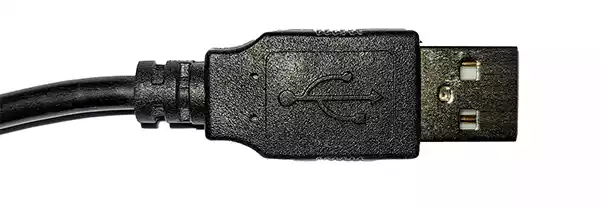
Clearly, you need a USB adapter, because a USB-A connector won't fit into a USB-C port. But don't jump over to Amazon or eBay and get the first adapter you find, because there's a chance it won't work.
What you need is a USB-C or Micro-USB OTG adapter.
OTG stands for On-The-Go. An OTG adapter or cable connects to your Android device on one side and has a female USB-A plug on the other side, allowing you to connect to external devices such as keyboards, memory sticks, and USB microphones. They are available for mobile devices with either micro-USB or USB-C ports.
I use a Samsung A53 5G phone, a mid-range phone with good audio and video recording capabilities. To connect a Blue Yeti to the Samsung A53-5G I use a Syntech USB C to USB OTG Adapter. It has male USB-C to female USB-A connectors. But if your device has a micro-USB port instead of USB-C, you'll need the appropriate OTG adapter.
For Android phones with USB-C ports, I recommend the Syntech adapter. I have used it with various apps on my Samsung A53-5G phone and I know it works.
Sale

Syntech USB C to USB Adapter Pack of 2 USB C Male to USB3 Female Adapter...
- Design: The adapter is gathered with zinc alloy metallic minimalist design and delicate embossment...
- Compatibility: This USB C to USB adapter is compatible with MacBook Pro after 2016 and MacBook Air...
- User Friendly and USB3 Speed: Plug and work; Plug the USB C end of the adapter into a USBC port, and...
- Connectors: Engineered for enhanced durability, the male USB C and female USB3 connectors are...
Last update on 2022-07-06 / Affiliate links / Images from Amazon Product Advertising API
An optional accessory you may also want to use is a set of headphones with a 3.5mm headphone jack. This is to connect to the Blue Yeti's headphone socket that will enable you to monitor your audio and playback from your Android device.
How to connect blue yeti to an Android phone
Connecting a Blue Yeti USB microphone to your Android phone or device will dramatically improve your sound when using an audio/video recording app, or video conferencing app.
So, this is what you need to do.
- Insert a Syntech OTG adapter into the USB-C port of your Android phone.
- Plug the USB-A end of the Blue Yeti USB microphone cable into the female USB-A socket of the Syntech adapter.
- Connect the mini-USB end of the USB mic cable to the socket on the base of the Blue Yeti. You should see the red power LED on the mic's mute button light up, indicating that the connection has been made and the mic is receiving power.
- To monitor your audio and hear the playback of your audio or video recordings, plug your headphones into the 3.5mm jack on the base of the Blue Yeti.
- Now open the audio or video app you want to use.
That's essentially it. Your Blue Yeti should now be connected to your Android phone and you're Yeti should be used by any audio or video recording apps, or conference call apps.
If you're using a different make of USB microphone the instructions to connect to an Android device are the same. However, the USB socket on your microphone may be USB-B or micro-USB, depending on the model of the microphone. That won't be an issue, since the other end of the cable will probably have a standard USB-A plug. If your USB mic uses a cable that ends with a USB-C connector you should be able to plug it straight into your phone's USB-C port.
Using your Blue Yeti to record videos on your Android phone
Now that you have connected your Blue Yeti USB microphone to your Android phone you obviously want to use it. If you're a creator or YouTuber who needs to record videos, your first option might be to use the camera app that comes with your phone.
If you are a Samsung user, you should be OK with the camera app that shipped with your phone. At least that is the case with my Samsung A53-5G phone, which works fine with my Blue Yeti. The procedure is to open the camera app, choose the video option, select the resolution/aspect ratio you want, then tap the record button. At the start of the recording, you should see a notification letting you know that the video camera is using what it thinks is your headset microphone. We know that it will be your Blue Yeti.
Unfortunately, some Android phones come with camera apps that only select the built-in microphone as the audio source. You can get around this problem by downloading the free Open Camera app from the Google Play store. Go into the Video settings and choose Audio source. You can then select External mic.
Using your Blue Yeti to record audio files on your Android phone
If all you need to do is record your spoken word and then do simple editing, you could use the Samsung Voice Recorder app. Voice Recorder lets you choose the recording quality, with the following being available – High (256kbps/48kHz), Medium (128kbps/44.1kHz), and Low (64kbps/44.1kHz). While you are in your settings it might also be worthwhile selecting "Block calls while recording".
Standard Mode is a simple recorder. Tap the red record button and start speaking. Once you've saved your audio you can do some simple editing. This could be cropping off the beginning and end. You can also cut out sections in the recording that you don't need or where you messed up and started again.
The other mode in Voice Recorder is rather neat. It's Speech-to-Text Mode and it could be of interest to Creators looking to maximize their time. Tap the red record button, start speaking, and see your speech appear as text on the screen of your device. Once you're done, saving the audio memo will save the recording and text. You can then export the text, audio, or both to your favorite cloud-based storage for later editing. Once you get used to working this way you could end up with the audio for a podcast and an article for your blog.
Conclusion
You can use the Blue Yeti, and other USB microphones, with your Android phone. Most recent Android phones, like the Samsung A53-5G or Galaxy S20FE, have a USB-C data and charging port, and it is this port you need to connect the microphone. But most USB microphones use cables that have a USB-A connector at the end, which obviously cannot connect to the phone. To overcome this problem, we can use a USB-C to USB-A or micro-USB to USB-A OTG adapter. Although it is possible to record onto an Android phone using a USB mic that does not offer headphone monitoring and playback, it is much more convenient to use a USB microphone that has zero-latency monitoring and playback. Effectively, this means the microphone has a built-in sound card.
Tosh Lubek runs an audio and video production business in the UK and has been using the Canon EOS R since it was released in the Autumn of 2018 and the Canon EOS R6 in 2020. He has used both cameras to shoot TV commercials broadcast on Sky TV, promotional business videos, videos of events and functions, and YouTube creator content. He has also won several international awards for his advertising and promotional work. You can meet him by visiting his "video booth" at HashTag Business Events across the country.
Source: https://www.diyvideostudio.com/how-to-connect-blue-yeti-or-usb-mic-to-samsung-android-phone/
0 Response to "Can You Use an Otg Cable to Connect Blue Mic to Cell Phone"
Post a Comment